

Last Updated: October 23, 2026
Quick Summary
Design sports team uniforms by starting with a planner that collects your roster, league rules, color codes, logo files, budget, and deadline before opening any design tool. Then choose contrasting colors, pick design software, lock in jersey cut and lettering, and approve a proof in writing. Build a budget that covers the base order, a reorder reserve, and a revision buffer.
- Collect roster sizes, league rules, color codes, vector logos, budget, and deadline in one planner document.
- Pair dark jerseys with light numbers and test every color combination in grayscale.
- Order one sample jersey in your chosen cut before committing the full roster.
- Sublimation dyes full-color designs into fabric but works on light polyester only.
- Production typically runs 8-12 business days once all team orders are in.
Table of Contents
- Start With a Team Uniform Design Planner
- Choosing Team Uniform Colors and Logos That Read on the Field
- Picking Sports Uniform Design Software
- Jersey Style, Cut, and Fabric Performance
- Names, Numbers, Fonts, and Print-Ready Artwork
- Custom Team Jerseys: Decoration Methods and Production
- Sport-Specific Rules, Compliance, and Inclusive Sizing
- Budgeting, Turnaround, and Reordering
- Frequently Asked Questions
Start With a Team Uniform Design Planner
Designing sports team uniforms starts with a planner, not a design tool. Gather the roster, sport rules, color codes, and budget in one document before opening any software; teams that skip this step usually rebuild their designs two or three times, and each revision costs another approval round.
What to Collect Before You Open a Design Tool
A team uniform design planner is one working document holding every decision your uniform depends on. Collect these first:
- Roster with sizes and numbers. Full names, numbers, and measurements for every player, including late additions.
- Sport and league rules. Number size, placement, and color contrast requirements vary by sport.
- Color codes. Exact hex or Pantone values if your school or club has brand guidelines.
Avoid collecting sizes by text message. Build a shared form so every player submits the same fields in the same format.
Choosing Team Uniform Colors and Logos That Read on the Field
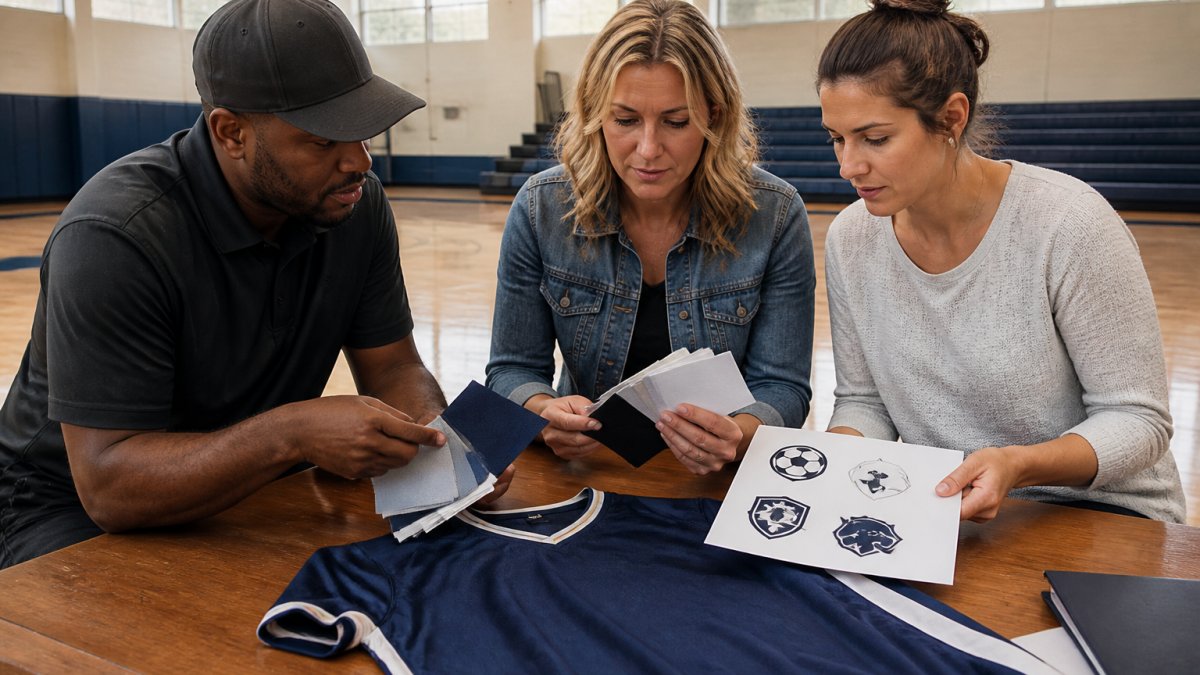
Team uniform colors and logos have one job: instant recognition from the bleachers. Pick a primary, secondary, and contrast color for numbers, then test the combination at a distance before committing.
Color Contrast and Number Legibility
Number legibility depends on contrast, not color preference: dark numbers on a dark jersey disappear at 50 yards, however good the design looks on screen. Follow these rules:
- Pair dark jerseys with light numbers and light jerseys with dark numbers.
- Keep at least one strong contrast edge around every number.
- Avoid two mid-tone colors side by side; they blur together in motion.
When you finalize a logo, see how it translates onto uniforms and gear by browsing a team logo decal pack; small-format decals expose detail that gets lost in embroidery or print.
Picking Sports Uniform Design Software
Sports uniform design software should do three things well: show a realistic mockup, accept your artwork files, and export a proof your whole team can approve. Anything beyond that is convenience.
Online designers run in a browser and suit quick mockups and simple layouts; professional vector software gives full control but requires expertise.
Judge any design tool on these points:
- Does the mockup show actual fabric colors, or just flat screen colors?
- Can it accept vector artwork, or only image uploads?
- Does it generate a shareable design preview for approvals?
A design concept built inside the tool your printer uses saves a translation step later. Ask which file format your supplier prefers before you start drawing.
Jersey Style, Cut, and Fabric Performance
Jersey style and cut affect how players move and how long the uniform lasts. Match the garment to the sport first, then choose fabric weight and construction based on heat, contact level, and wash frequency.
Hockey and lacrosse jerseys need room through the shoulders for pads. Basketball and soccer uniforms need a closer cut that will not snag. Fabric performance matters just as much as fit:
- Moisture-wicking synthetics dry fast and suit high-sweat sports.
- Reinforced shoulder and elbow seams survive contact sports far longer than standard stitching.
- Sublimated fabric holds color through repeated washing because the dye sits in the material, not on top of it.
If you want to compare actual cuts and materials side by side, browse sports hockey jerseys to see how different styles are built before you lock in a design.
Names, Numbers, Fonts, and Print-Ready Artwork
Player names and numbers must be readable at a glance and survive the season. Choose a bold, block-style font, size numbers to your league's minimum, and send vector artwork with all text converted to outlines.
Lettering decisions to lock down before production:
- Font: avoid thin scripts; they break up at distance and in small print sizes.
- Number placement: confirm front, back, and sleeve rules for your sport.
- Name format: last name only is standard; confirm capitalization with your league.
To see how lettering and numbering are actually applied to finished garments, review the available jersey lettering options before you finalize your roster sheet.
Custom Team Jerseys: Decoration Methods and Production
Custom team jerseys get their color and lettering through one of three decoration methods, each affecting durability, cost, and design limits. Understand the trade-offs before approving a quote.
| Method | How It Works | Best For | Watch Out For |
|---|---|---|---|
| Sublimation | Dye bonds into the fabric | Full-color designs, all-over patterns | Works on light polyester only |
| Heat transfer | Printed film pressed onto fabric | Names and numbers on finished garments | Can peel if pressed poorly |
| Screen printing | Ink pushed through a stencil | Bold, simple designs in bulk | Setup cost per color |
Production follows a set order: artwork approval, proof sign-off, printing or pressing, cutting and sewing, then quality check.
Our own production runs on a per-order basis, with turnaround typically landing in the 8-12 business day range depending on the item and once all team orders are in.
Sport-Specific Rules, Compliance, and Inclusive Sizing
Sport-specific design rules are not optional, and leagues enforce them at check-in. Number size, placement, and contrast requirements differ by sport and level, so confirm your league's current rulebook before finalizing artwork. The table below is a starting checklist, not a substitute for the written rules.
| Sport | Number Placement | Typical Minimum Number Size | Contrast and Logo Notes |
|---|---|---|---|
| Football | Front and back, plus shoulder numbers at most levels | Back numbers are the largest requirement; front numbers are smaller | Numbers must contrast sharply with the jersey body; league marks are usually restricted to sleeves or the collar |
| Basketball | Front and back | Front numbers are smaller than back numbers | Front and back numbers must be a single solid color that contrasts with the jersey; no gradients or patterns inside the number |
| Soccer | Back, plus a small front number on many kits | Back numbers are the primary requirement | Goalkeepers must wear a color distinct from both teams and the referee; league and competition logos are limited in size and placement |
| Hockey | Back, plus sleeve numbers | Back numbers are the largest; sleeve numbers are smaller | The captain's "C" and alternate captain's "A" are governed separately; nameplates follow a set height and letter style |
| Baseball and softball | Back | Back numbers are the standard requirement | Front jersey logos and sleeve patches are the usual branding space; pant and belt colors are often regulated |
| Volleyball | Front and back | Front numbers are required, not optional | Numbers must contrast with the jersey and be positioned so they stay visible during play |
Three compliance details trip up teams again and again:
- Number style. Many leagues require solid-color block numerals and prohibit outlines, drop shadows, or patterns inside the number. A design that looks sharp in a mockup can fail check-in if the numeral has a two-tone fill.
- Contrast, not color. A league that requires "contrasting" numbers is asking about light-versus-dark, not about which colors you picked. Test the combination in grayscale before you approve artwork.
- Logo and branding limits. Many leagues restrict logo size and placement, and some govern how much of the uniform can carry commercial branding. Get the rules in writing from your league office, and keep a copy with your design files.
Inclusive Sizing and Accessibility
Inclusive sizing deserves the same attention as compliance. Build a full size range into your order, collect player measurements rather than guessing, and confirm the size chart with your supplier. Two accessibility points are easy to overlook:
- Number contrast for color-vision differences. Red-on-green and similar pairings can read as a single tone for players and officials with color-vision deficiency. A light number on a dark jersey, or the reverse, stays legible regardless of which colors a viewer can distinguish.
- Fit across body types. Ask your supplier whether the cut is available in extended sizes and whether the same decoration method works across the full range. Some methods behave differently on larger panels, and confirming that early avoids a split order.
For programs that need compliant, size-inclusive gear across multiple sports, browse custom team polos as a versatile option that works for coaches, staff, and fan wear.
Budgeting, Turnaround, and Reordering
Uniform budgeting should cover more than the first order: the initial purchase, a reorder reserve for roster changes, and replacement of damaged pieces mid-season. Per-player cost moves with five variables, and understanding them separates a budget that holds from one revised twice.
What Drives the Per-Player Cost
- Garment quality and construction. A heavier fabric with reinforced seams costs more up front but usually outlasts a lighter garment across multiple seasons. Divide the garment price by the number of seasons you expect to use it to compare fairly.
- Decoration method. Screen printing carries a setup cost per color, so it rewards large, simple orders and penalizes small runs and multi-color designs. Sublimation prices full-color, all-over designs without a per-color setup. Heat transfer sits between the two and is common for names and numbers added to finished garments.
- Order quantity. Most suppliers price per unit on a curve: the per-piece cost drops as quantity rises because setup and production time are spread across more units. Ordering the full roster plus spares in one run is usually cheaper per player than placing two smaller orders.
A Practical Budget Structure
- Base order: full roster, plus two or three spare pieces in common sizes.
- Reorder reserve: set aside enough to add players after tryouts or transfers. Ask whether your supplier keeps your artwork and roster on file; reorders are simpler and usually cheaper when they do.
- Replacement fund: a small buffer for lost or damaged items.
Total Cost of Ownership
Total cost of ownership matters over a season, not the sticker price of one jersey. A cheaper garment that fades or loses its lettering after a dozen washes costs more in replacements than a better-built piece. When comparing quotes, ask each supplier: How many washes is the decoration rated for? Are seams reinforced at contact points? Is the fabric weight appropriate for the sport?
Turnaround and Deadline Math
Turnaround time drives your deadline math. Work backward from your first game: confirm the production window, add shipping, and leave a buffer for proof revisions. Our production runs per order, typically 8-12 business days depending on the item and once all team orders are in.
To plan costs and see current pricing on team gear, check the sports team sales page before you finalize your budget.
Frequently Asked Questions
How do I design my own uniform?
Start by writing down the roster, sport, season dates, and budget before you touch any design tool. Then pick team colors and a logo that stay legible at distance, choose a jersey cut that matches the sport, and set name and number fonts. Build the design in an online designer or a sports uniform design software tool, request a mockup, and approve a physical or digital proof before production. Keep a copy of the final artwork file so reorders match.
How can I create custom team jerseys on a tight budget?
Limit the number of colors in the print, skip optional add-ons like matching socks in year one, and order the full roster in one batch to avoid small-run pricing. Custom team jerseys at Custom Online Prints start at $28 for the Puck Slayers Vegas/Black jersey and $42 for the Florida Star Team Jersey, so a 15-player roster can be outfitted for roughly $420 to $630 before names and numbers. Confirm turnaround (8-12 business days on most jerseys) so you are not paying rush fees.
What is the best app for designing uniforms?
There is no single best app. Look for a sports uniform design software tool that shows a 3D or flat mockup, lets you upload vector artwork, includes a size chart, and produces a downloadable proof. The tool matters less than the output: you want a print-ready file with correct color values and number placement. Ask whether the designer is tied to a specific supplier, because a design built in one vendor's tool usually cannot be sent to another printer.
What should you consider when choosing colors for team uniforms?
Contrast is the deciding factor. Dark numbers on a dark jersey disappear from the stands and on video, so pair a dark base with light numbers or add an outline. Check how your school or league colors look in flat print versus fabric, since screen colors shift. Also confirm you have a light and dark kit if your league requires a color clash rule, and keep the palette to two or three colors so the print stays clean.
How do you choose the right fabric for sports uniforms?
Match the fabric to the sport and the sweat level. Look for moisture-wicking polyester knits for hockey, soccer, and basketball, and heavier abrasion-resistant fabric for anything with contact or sliding. Ask about weight in grams per square meter and whether the fabric is dye-sublimation ready, since sublimation bonds into the fiber and will not peel.
What information should you gather before ordering team uniforms?
Collect the full roster with correct spelling of every player name, each player's number and size, the sport and league rulebook, your color values, a vector logo file, the season start date, and your total budget. Add a signed size chart and one approved proof. Missing any of these is the most common cause of late orders, wrong numbers, and reprints, so build the list into your team uniform design planner before you request a quote.
Designing team uniforms gets far easier when the planning happens before the design. Custom Online Prints supports that process with dedicated team sales portals, custom printed canopies in multiple sizes, custom helmet and hard hat decals, and a broad selection of team fan apparel, all ordered through one streamlined platform. Get started with Custom Online Prints and give your team gear that holds up from the first game to the last.
